

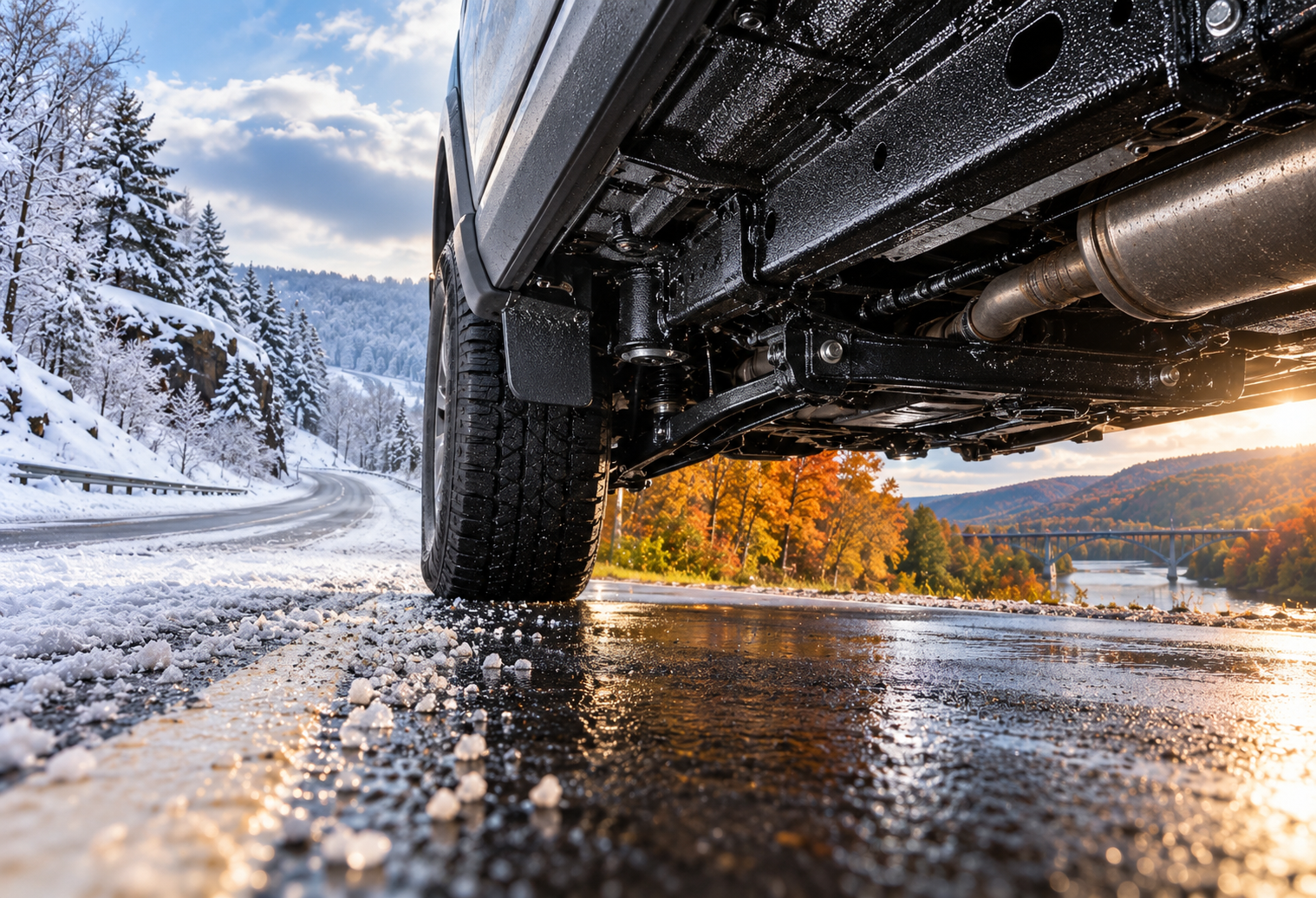
Pennsylvania winters can be hard on more than tires and batteries. Around Sugarloaf, Hazleton, and the surrounding Luzerne County area, vehicles regularly encounter snow, slush, moisture, road salt, and brine during the winter driving season. Those conditions make corrosion prevention worth considering, especially for vehicles owners plan to keep for years.
Quick answer: Yes, vehicle undercoating can be worth it in Pennsylvania because it adds a protective layer between vulnerable underbody surfaces and the moisture, salt, and road treatments encountered during winter driving. It does not make a vehicle immune to rust, but proper application and ongoing maintenance can be part of a practical corrosion-prevention plan.
What local drivers should know
-
Pennsylvania uses salt, salt brine, and other materials to manage snow and ice on state roads during winter weather.
-
Luzerne County’s combination of freezing weather, snow, wet roads, and winter treatments can repeatedly expose a vehicle’s underside to corrosive conditions.
-
Undercoating works best as preventive maintenance rather than as a way to repair metal that has already suffered serious corrosion.
-
Trucks, SUVs, work vehicles, and daily drivers can all benefit from having their underbody condition evaluated.
-
Undercoating should still be inspected periodically because protective material can wear or require maintenance.
Why Is Undercoating Worth Considering in Pennsylvania?
Undercoating is worth considering in Pennsylvania because winter driving repeatedly exposes the underside of a vehicle to moisture and deicing materials, creating conditions that can contribute to corrosion over time.
PennDOT reports that salt remains a primary material for fighting winter storms and that salt brine is also used for anti-icing and pre-wetting road salt. Across Pennsylvania, PennDOT reports an average of roughly 598,000 tons of salt used over the last five winters.
That statewide picture becomes especially relevant around Sugarloaf. PennDOT’s published winter facts list Luzerne County at an average of 31 inches of snow and report 29,796 tons of salt and 368,659 gallons of brine used in the county’s winter operations data.
For local drivers traveling through Sugarloaf Township, Hazleton, Conyngham, Drums, and other nearby communities, winter residue can reach exposed metal, seams, suspension areas, and other parts underneath a vehicle.
Ultimate Undercoating serves drivers looking to protect vehicles against those regional conditions. From this point forward, we focus on helping vehicle owners understand their options and choose an approach appropriate for the condition of their vehicle.
What Does Local Winter Road Treatment Mean for Your Vehicle?
Local winter road treatment means vehicles can encounter salt and brine repeatedly throughout the cold-weather season, particularly during periods of snow, ice, freezing temperatures, and subsequent wet-road conditions.
PennDOT explains that crews can apply salt brine before storms to help prevent snow and ice from bonding to pavement. During storms, salt and anti-skid materials may also be applied, with the specific approach depending on road conditions and traffic.
That matters because exposure is not necessarily limited to the day of a snowstorm. Residue can remain on wet or dirty roads after precipitation ends. A vehicle traveling regularly between Sugarloaf, Hazleton, Drums, and surrounding Luzerne County communities may therefore encounter winter road residue throughout the season.
How Can Pennsylvania Winters Affect a Vehicle’s Undercarriage?
Pennsylvania winters can affect a vehicle’s undercarriage by repeatedly exposing metal components and vulnerable surfaces to moisture, road grime, salt, and deicing residue.
Corrosion can begin in places drivers rarely see during normal use. The underside contains seams, cavities, brackets, fasteners, frame or structural components, and other areas where contaminants may collect.
The issue can be particularly easy to overlook because a vehicle may look excellent from the doors upward while deterioration develops underneath.
That is one reason preventive underbody care makes sense for local drivers who expect to keep a car, pickup, SUV, commercial vehicle, or work truck for the long term.
What Are the Warning Signs of Underbody Corrosion?
Warning signs of underbody corrosion include visible rust, flaking metal, deteriorating protective coatings, corrosion around fasteners and seams, and areas where existing protection has worn away.
Drivers should watch for:
-
Orange or brown discoloration on exposed metal.
-
Scaling, bubbling, or flaking surfaces underneath the vehicle.
-
Rust developing around seams, brackets, and mounting points.
-
Existing factory or aftermarket coating that is cracked, damaged, or missing.
-
Heavy accumulation of dirt and winter residue in underbody areas.
-
Corroded fasteners or hardware.
-
Rust becoming visible around lower body panels or wheel areas.
Surface discoloration and severe deterioration are not the same thing. If you are unsure what you are seeing, an inspection can help establish the vehicle’s actual condition before deciding on treatment.
When Should You Have a Vehicle Professionally Undercoated?
A vehicle should be professionally evaluated for undercoating before corrosion becomes advanced, with particular attention given before or around Pennsylvania’s winter driving season.
A newer vehicle may be a straightforward candidate for preventive treatment. An older vehicle can still be worth evaluating, but existing rust, loose material, dirt, and previous coatings need to be considered before anything is applied.
This is where preparation matters. Simply covering questionable areas without assessing what is underneath them is not a substitute for proper corrosion prevention.
Around Sugarloaf and the greater Hazleton area, it makes sense to think about underbody protection before repeated winter exposure rather than waiting until significant rust is obvious.
What Common Local Conditions Contribute to Vehicle Rust?
The most common local conditions that contribute to vehicle rust are road salt, salt brine, moisture, repeated winter storms, and contaminants that remain on or underneath a vehicle.
1. Road salt and brine: PennDOT uses these materials as part of winter road maintenance, making exposure a normal part of cold-weather driving in Pennsylvania.
2. Snow and slush: Wet winter material can reach areas throughout the undercarriage as a vehicle travels.
3. Freeze and thaw conditions: Pennsylvania vehicles can move repeatedly between freezing outdoor conditions and warmer periods, while accumulated moisture and road residue remain underneath.
4. Rural and secondary-road driving: Drivers around Sugarloaf Township and neighboring communities may travel a mix of state highways, local roads, and lower-volume routes. PennDOT notes that winter treatment methods can vary with traffic volume and roadway conditions.
5. Long-term exposure: A single winter drive is not the main concern. Repeated seasonal exposure over several years is what makes corrosion prevention particularly relevant for owners planning to keep their vehicles.
How Can Pennsylvania Drivers Help Prevent Underbody Rust?
Pennsylvania drivers can help prevent underbody rust by limiting long-term buildup of winter residue, inspecting vulnerable areas, and maintaining an appropriate protective treatment.
Washing winter residue from the vehicle can be useful, particularly after periods of heavy salt exposure. Pay attention to wheel wells and accessible underbody areas rather than focusing only on painted exterior surfaces.
Drivers should also periodically inspect existing protection. Undercoating is not something to apply once and then forget indefinitely. Its condition should be checked, especially after another Luzerne County winter.
DIY inspection is reasonable when it can be done safely without getting underneath an improperly supported vehicle. More detailed inspection, preparation, or coating work should be handled with appropriate equipment.
What Results Should You Expect From Vehicle Undercoating?
Vehicle undercoating should provide an added protective barrier against environmental exposure, but drivers should view it as corrosion prevention and maintenance rather than a permanent cure for rust.
The condition of the vehicle before treatment matters. A clean vehicle with limited corrosion presents a different situation from an older truck that has already spent many winters on Pennsylvania roads.
Realistic expectations are important. Undercoating does not reverse structural rust or restore deteriorated metal. Its purpose is to help protect appropriate surfaces and reduce direct exposure to conditions that contribute to corrosion.
What Mistakes Should Pennsylvania Drivers Avoid?
Pennsylvania drivers should avoid treating undercoating as a simple matter of spraying over everything underneath a vehicle, because preparation, existing corrosion, coverage, and future inspection all matter.
Mistake: Waiting for major rust to appear.
Consequence: Preventive options become more limited once corrosion is advanced.
Better approach: Inspect the underbody before serious deterioration develops.
Mistake: Applying material over loose rust or contamination.
Consequence: The coating may hide rather than address an existing problem.
Better approach: Evaluate and prepare the surface appropriately before treatment.
Mistake: Assuming one application lasts forever.
Consequence: Wear can go unnoticed through multiple winters.
Better approach: Inspect the protection periodically and maintain it when appropriate.
Mistake: Ignoring a vehicle because it is relatively new.
Consequence: Years of Pennsylvania winter exposure can accumulate.
Better approach: Consider corrosion prevention while the underbody is still in good condition.
What Is a Common Undercoating Scenario Around Sugarloaf?
A common Sugarloaf-area scenario is a driver with a pickup, SUV, or daily commuter that is mechanically sound but has already experienced several northeastern Pennsylvania winters.
The exterior may still look clean, yet an underbody inspection reveals areas exposed to years of road grime and winter treatment residue. The owner wants to keep the vehicle rather than replace it in the near future.
In that situation, the first step is evaluating the existing condition. If undercoating is appropriate, proper preparation and coverage can become part of the vehicle’s ongoing corrosion-prevention plan.
This is a representative local scenario, not a specific customer case study.
What Undercoating Solutions Are Available for Local Vehicles?
Undercoating solutions are intended to protect appropriate underbody surfaces from direct exposure to moisture, salt, and road contaminants, with the right approach depending on the vehicle and its existing condition.
At Ultimate Undercoating, we can help local drivers evaluate whether undercoating makes sense for their car, truck, SUV, or work vehicle. The goal is to address corrosion prevention before another season of northeastern Pennsylvania winter driving adds more exposure.
Is DIY or Professional Undercoating the Better Option?
DIY and professional undercoating can both add protection, but professional service can provide a more controlled process for inspecting the vehicle, preparing accessible surfaces, and applying treatment to appropriate areas.
DIY products may appeal to drivers comfortable maintaining their own vehicles. The challenge is gaining safe access underneath the vehicle, identifying existing corrosion, preparing surfaces correctly, and achieving thorough coverage without coating components that should remain untreated.
For drivers around Sugarloaf who want a more complete approach, professional evaluation can remove much of that uncertainty.
Where Do We Serve Around Sugarloaf?
Our Sugarloaf location is positioned to help vehicle owners in the surrounding Hazleton and Luzerne County area who deal with the same northeastern Pennsylvania winter conditions.
That includes drivers from Sugarloaf Township and nearby communities such as Hazleton, Conyngham, Drums, and other surrounding areas.
What Can Happen If You Ignore Underbody Corrosion?
Ignoring underbody corrosion can allow deterioration to progress unnoticed, potentially affecting components and metal surfaces that are considerably more difficult to address after rust becomes severe.
The risk tends to increase with time and repeated exposure. Another winter means another season of wet roads, snow, salt, and brine.
Drivers do not need to panic over every spot of surface rust, but visible corrosion is a good reason to assess the vehicle instead of simply waiting another few Pennsylvania winters.
Frequently Asked Questions About Undercoating in Pennsylvania
Is vehicle undercoating worth it in Pennsylvania?
Yes, undercoating can be worthwhile in Pennsylvania for owners who want to reduce their vehicle’s long-term exposure to moisture and winter road treatments. PennDOT uses salt and brine extensively during winter operations, so corrosion prevention can be particularly relevant for vehicles driven year-round.
Is undercoating useful around Sugarloaf, PA?
Yes, undercoating can be useful around Sugarloaf because vehicles in this part of Luzerne County encounter snow, freezing conditions, wet roads, salt, and brine during winter. The value is especially worth considering when you plan to keep the vehicle through several more winter seasons.
How much snow does Luzerne County get?
PennDOT’s published winter facts list Luzerne County at an average of 31 inches of snow. The same county data reports substantial salt and brine use as part of winter operations, illustrating why underbody corrosion prevention is relevant to local vehicle owners.
Does Pennsylvania use brine on winter roads?
Yes, PennDOT uses salt brine as part of its winter operations. Brine can be applied before freezing precipitation to help prevent ice from bonding to pavement, and it can also be used with other winter materials.
Should I undercoat a brand-new vehicle in Pennsylvania?
A newer vehicle can be a good candidate for preventive undercoating because its underside may have less existing corrosion to address. The appropriate treatment still depends on the particular vehicle, its existing factory protection, condition, and how it will be used.
Can you undercoat an older vehicle with rust?
An older vehicle may still be a candidate for undercoating, but existing rust should be evaluated first. Undercoating should not simply conceal loose, scaling, or serious corrosion. The condition of the metal and existing coatings helps determine what preparation or other work may be appropriate.
When is the best time to undercoat a vehicle in Sugarloaf?
Before sustained winter exposure is a practical time to consider undercoating in Sugarloaf, although a vehicle can be evaluated at other times of year. The important factors are the underbody’s condition, proper preparation, and completing appropriate protection before additional exposure whenever possible.
Does undercoating permanently stop rust?
No, undercoating should not be viewed as a permanent guarantee against rust. It is a protective measure designed to reduce exposure of appropriate surfaces to moisture, salt, brine, and other contaminants. Periodic inspection and maintenance remain important, particularly for vehicles driven through Pennsylvania winters.
Protect Your Vehicle From Another Pennsylvania Winter
Living and driving around Sugarloaf means winter road treatments are part of vehicle ownership. Taking a preventive approach to the underside of your vehicle can help you manage that exposure before corrosion becomes a larger concern.
Help Protect Your Vehicle From Pennsylvania Road Salt
We help local vehicle owners take a practical, preventive approach to underbody protection based on the condition of their vehicle.